
Western Spotted Skunk
Weasel Family
Classification: Predatory Wildlife Species*
Spilogale gracilis
Order: Carnivora
Family: Mustelidae
Status: considered a native species, but it's less common and more elusive than the striped skunk, preferring brushy riparian areas and appearing in various counties.
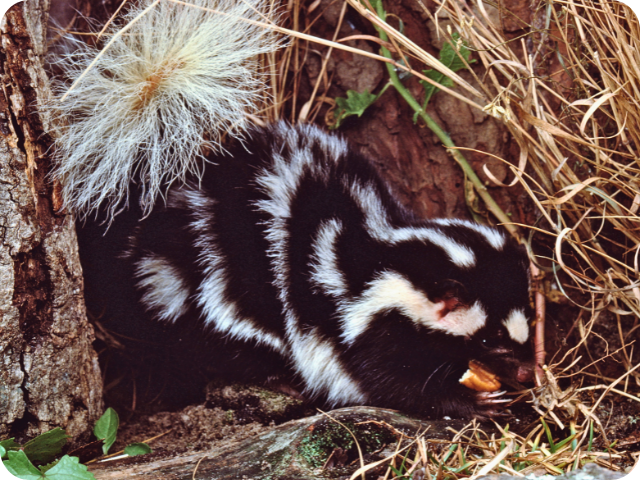
Identifying Characteristics: The distinctive black and white pattern of spots and stripes and much smaller size of the Western Spotted Skunk distinguish them from the more common Stripped Skunk. Well-developed scent glands that emit a very strong odor. Often the presence of a skunk is first detected by its odor. Great variation in color pattern and size of stripes.
*Can be hunted or trapped
Best Management Practices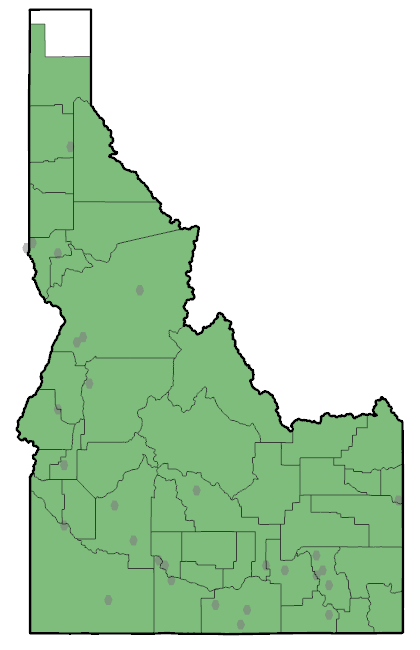
Total length: 15 to 16 inches. Weights: 1 to 1.25 pounds.
Habitat: They have been found in arid, rocky and brushy canyons and hillsides. Information from other portions of its range suggest that when they are inactive or bearing young they occupy a den in rocks, burrows, hollow logs, brush piles, or under buildings.
Food Habits: Diets of Western Spotted Skunks include insects, rodents, small birds, and possibly bird eggs constitute most of their diet. Reptiles and amphibians are also taken, as are many types of fruits and berries.
Life History: a secretive, nocturnal mammal, part of the skunk family known for its acrobatic handstand defense; they breed in late summer/early fall, have delayed implantation, giving birth to 2-5 kits in May after a long gestation, and become sexually mature within months, living in varied habitats and playing a role in pest control, though populations are declining due to habitat loss and other factors.
Similar Species: most similar to its closest relative, the Eastern Spotted Skunk (S. putorius), with other similar species in the same genus (Spilogale) including the Southern Spotted Skunk (S. angustifrons) and Pygmy Spotted Skunk (S. pygmaea), all sharing the distinctive spotted pattern but differing in geographic range and stripe patterns, especially the Western's more white tail tip and broader stripes compared to the Eastern's broken stripes and climbing ability.
The Latin word "mephitis" translates to "bad odor", and many people would agree that the name "bad odor - bad odor" aptly fits the spotted skunk.
Description
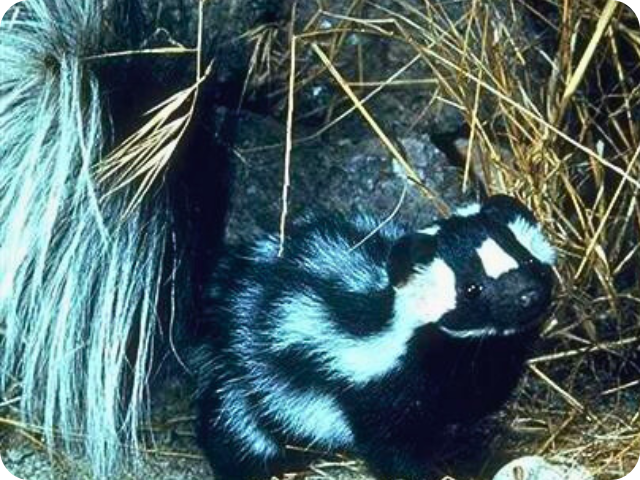
The Western Spotted Skunk is a small, relatively
slender skunk with glossy black fur interrupted with
distinct white stripes on the forward part of the body.
The posterior part of the body has two interrupted white
bands with one white spot on each side of the rump and
two more at the base of the tail. The pattern of white
lines and spots is individually unique. The top of the
tail is black and the underside is extensively white.
The tip of the tail is white. A white spot is present
on the forehead and another in front of each ear.
The distinctive black and white pattern of spots and stripes and much smaller size of the Western Spotted Skunk distinguish them from the more common Stripped Skunk (Mephitis mephitis), which have two solid white stripes along the side of the body and are nearly twice as large.
The color pattern resembles that of the Eastern Spotted Skunk, but the white markings are more extensive. The black and white stripes on the upper back are nearly equal in width whereas in the Eastern Spotted Skunk the black areas are much more extensive than the white. The tip of the tail is white while the tail tips of Eastern Spotted Skunks are black. In addition to external characteristics, the breeding cycle of the spotted skunks are different.
The scent glands in skunks are well developed. Musk, or essence, can be sprayed repeatedly as a defense. The yellowish compound is powerful in all skunks, and contains sulfuric acid which can cause temporary blindness in both other animals and man.
Spotted skunks have 5 toes on each foot. The front feet have relatively long claws to assist them in digging for grubs and other foods. They have 34 teeth, including 4 pointed and sharp canines teeth.
Skunk fur is rather long, and longer on tails than on bodies. Underfur is white under the white guard hairs, and grayish under the black colored guard hairs.
 Reproduction
Information suggests females
come into estrus in September and most of them are bred by
early October. Implantation of the embryo is delayed with
the blastula stage of the embryo spending 180 to 200 days
floating in the uterus of the female before becoming implanted.
An average of four young are born in late April and May after
a total gestation period of from 210 to 230 days. Young males
may become sexually mature when only 3 or 4 months of age.
Young leave the natal den about 1 month after birth and follow
their mother until weaned at 7 weeks of age. Eastern Spotted
Skunks do have delayed implantation. They mate between March
and April and are reproductively isolated from the Western Spotted Skunk.
Habits
Spotted skunks are more
agile than striped skunks. Their territory sizes are
similar to striped skunks. This species can climb
very well, and they descend trees head first.
When threatened, spotted skunks commonly do handstands, balancing on their front feet while they lift their bodies into the air. This balancing act usually lasts for about 5 seconds at a time. The species can spray an offender from this position.
Spotted skunks are almost strictly nocturnal, usually retiring to a den before daylight, and coming out only after dark in the evening.
Skunks are not true hibernators, but both species may spend weeks at a time in dens during cold temperatures and deep snow conditions. Striped skunks usually utilize underground dens that have been made by badgers, groundhogs or foxes. At times, they will tolerate other species in its den, even curling up and sleeping with a raccoon or opossum.
Spotted skunks prefer dens under or in old buildings. Oftentimes, a den will on the second floor of an old barn. Dens in haylofts are common, and the spotted skunks easily climb to the elevated areas.
Spotted skunks are more efficient than striped skunks as predators. These smaller skunks kill and eat significantly more mice and rats. Spotted skunks also frequent the edges of streams and ponds, and they do wade shallow water in pursuit of crayfish, a preferred food.
General
Although skunks are not well liked by people, they
do provide valuable services by controlling
significant numbers of injurious insects in the
larval stages. The diet of spotted skunks is almost
entirely beneficial to man. Both striped and spotted
skunks can raid chicken houses. The worst offender
is usually the spotted skunk because it can climb
easily to gain access.
Spotted skunks do dig up lawns in pursuit of grubs, and this is an annoyance to those who spend time and money to groom lawns.
Six years of age is considered old for either a striped or spotted skunk.