
Short-Tailed Weasel or Ermine

Weasel Family
Classification: Predatory Wildlife Species*
Other Names: Ermine, stoat
Status: Winter pelts of value when fur prices are high.
Mustela erminea
Order:
Carnivora
Family: Mustelidae
Identifying Characteristics: Of the three North American weasels is intermediate in size and one of the smallest carnivores in the world. Males distinctly larger than females. During summer fur is dark brown with white underparts, white feet, and white line down hind legs. Molts to white during winter, except black tip on tail.
*Can be hunted or trapped
Best Management Practices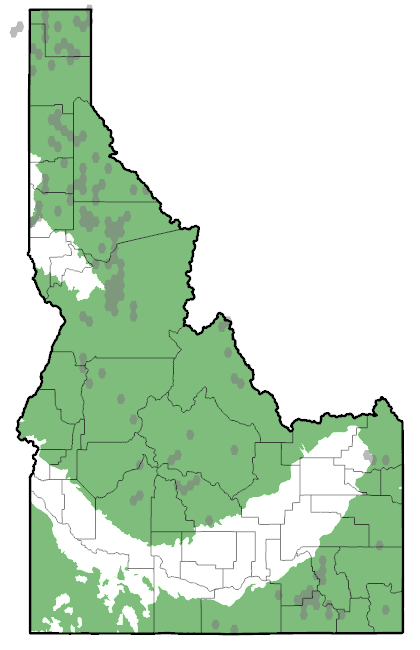
Total length: 7 to 13 inches. Weight: 1 to 6 ounces.
Habitat: Inhabits brushy or wooded areas, usually not far from water. Tends to avoid dense forest. Prefers areas with high densities of small mammals. Most abundant in ecotones.
Food Habits: Although short-tail weasels prey on a variety of small mammals and birds, they specialize in hunting voles.
Life History: Mostly nocturnal but will hunt during the day. Active throughout the year. Dens in ground burrows, under stumps, rock piles, or old buildings. Breeds during summer; 8.5 to 10 month gestation; delayed implantation; young born April or May; one litter per year of 4 to 13 young.
Similar Species: Long-tail weasel - larger, longer tail. Least weasel - smaller, short tail, no black tip on tail. Mink - larger, uniform color.
Characteristics
The short tailed weasel (Ermine) is noticeably
smaller, with a shorter tail, and varies from 8 to
14 inches long with a 4 1/2 inch tail. They weigh
from 1 1/4 to 5 ounces and are 2 to 3 inches high.
It has a long, slender, muscular body with short legs. The head is small, with beady eyes, small ears and a pointed nose. They move with quick movements and a graceful, bounding gait. Weasels change color with the seasons, and there is no color difference between the sexes. All the senses are well developed in the weasel.
In summer, the short-tailed weasel is dark brown on the back and legs. The chin, throat and undersides of the legs are white or a light yellow. In winter, it is entirely white, sometimes with yellowish stains on the lower abdomen. The tail has a black tip year round.
Life Cycle
The short-tailed weasel females mature at 3 to 4
months and males mature at about one year. The
breeding season is in July. There is a period of
delayed implantation with a gestation period of 9 to
10 months. The period of active pregnancy is 17 to
23 days.

Litter sizes varies from four to thirteen, with an average of six to eight. The young are born in April or May in nests constructed in underground dens or hay piles. Mouse nests and burrows are often used and heavily lined with fine grass and mouse fur. The male begins to bring food to the den about 1 month after the young are born. The young are weaned at the end of 5 weeks and are able to hunt for themselves by 7 or 8 weeks of age. The family stays together until late summer and then disperses. The life expectancy of weasels is short, probably less than a year, although they are capable of living as long as 6 years.
Food
Weasels prey on small rodents such as mice, rats,
voles, hares, rabbits, and chipmunks. They also take
shrews, birds, birds eggs, frogs, bats, insects,
earthworms and may occasionally kill domestic
chickens.
The weasel hunts by tirelessly and persistently investigating every small hole, crevice, bush or rock pile it encounters. They will track prey by following their scent trails and generally attack prey by ambushing and pouncing on it. They are very quick and kill by piercing the base of the skull with their teeth. The weasel frequently kills more than it can eat and often caches leftover food. The weasel can consume up to one third of its own weight in a 24 hour period.
Habits
Weasels are curious, alert and bold. They are
persistent hunters who seldom remain long in their
dens and may be abroad hunting at any hour, although
they are usually most active at night. Weasels are
active year round. Weasels occasionally hunt in
pairs but, for the most part, are solitary except
during breeding and rearing season. They are good
swimmers and can also climb trees. All species emit
a strong musk odor when alarmed, and the weasel may
stamp its feet when annoyed. Weasels may mark their
trails with droppings. Home ranges very from 30 to
400 acres.
Population
Weasel populations often cycle with mouse
populations. Several parasites can infect weasels,
such as guinea worm and kidney worms. These probably
have little impact on the population.
Weasels are subject to predation from hawks, owls, foxes, coyotes, dogs, cats and man.
In agricultural areas, weasels are more common due to the practice of storing grain which provides ideal conditions for mice.
Habitat
Weasels prefer woodlands or open country with
hedgerows, thickets or fence rows. They are usually
found near water but are not semi-aquatic as is the
mink. They frequent stone piles, brush heaps, wood
piles, hay stacks, log piles and old abandoned
buildings.
The short-tailed weasel inhabits brushy or wooded areas, usually not far from water. It tends to avoid dense forests.
The dens of weasels are shallow chambers about 6 inches underground with two to three entrances and are lined with mouse fur and grass.
Economic Value
The fur of the short-tailed weasel was once reserved
for use by royalty. The fur of the short-tailed
weasel is fine and of good quality and is used in
garments, lining and trim.
Weasels play an important role in helping to control rodent populations.