
Muskrat
Rodent Family
Classification: Fur Bearing Wildlife Species
Ondatra zibethicus
Order: Rodentia
Family:
Cricetidae
Status: Very abundant. One of the most important fur animals in North America. Can cause damage to dikes by burrowing. Very valuable fur animal. Furbearer managed and protected by regulated fur harvest seasons.
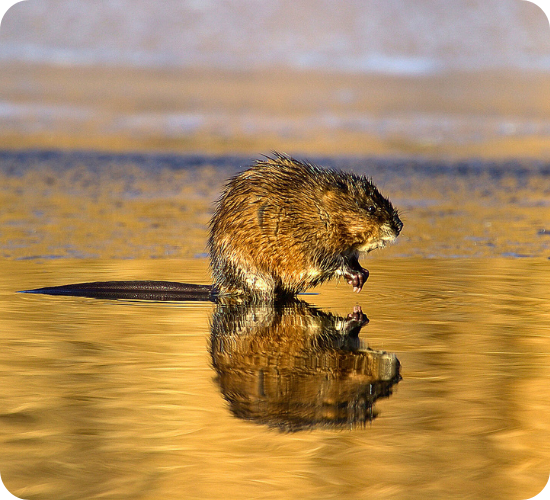
Identifying Characteristics: Muskrats are large voles adapted to aquatic conditions. The name muskrat is related to odoriferous secretions from the perineal glands. The long naked tail flattened laterally distinguishes muskrats from other mammals. Webbed hind feet. Fur is dense and rich brown and a coarse guard hair overlay and thick waterproof under layer. Color varies from dark brown to black.
Best Management Practices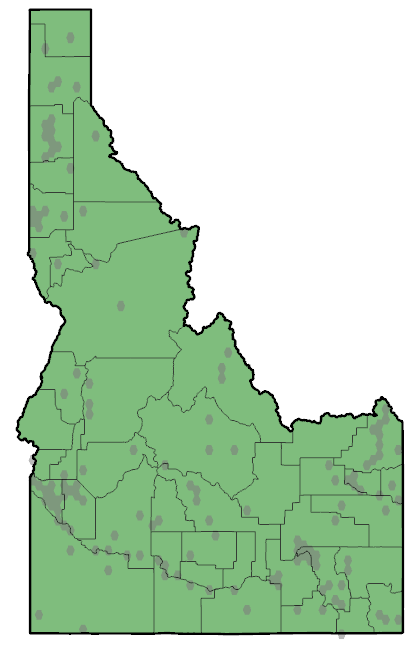
Total length: 16 to 26 inches. Weight: 2 to 4 pounds.
Habitat: The most widespread of North American microtine (a subfamily of mice) rodents. Marshes, edges of ponds, lakes, streams, cattails, and rushes are typical habitats. An essential habitat ingredient is water of sufficient depth or velocity to prevent freezing. The presence of herbaceous vegetation, both aquatic and terrestrial, is another essential ingredient. In general, has very flexible habitat requirements and often coexists in habitats used by beavers.
Food Habits: Primarily herbivorous and will eat virtually any vegetable matter. Utilizes shoots, roots, bulbs, and leaves of aquatic plants. Cattails and bulrush are preferred foods. Will also consume cultivated crops. On occasion will eat animal matter. Food is stored in the burrow or den and during winter may even eat part of its own lodge.
Life History: May be thought of as an overgrown subaquatic vole. Mostly active at night but daytime activity is not unusual. Often builds conspicuous dome-shaped houses. Breeds during spring and summer. 5 or 6 young are born after a 22 to 30 gestation. May have two or three litters per year.
Similar Species: Beaver - has large dorsally flattened scale over tail.
The muskrat is a common and valuable furbearer. Muskrats are widely distributed throughout North America. This species can adapt to a wide variety of climates. Muskrats are dependent upon habitats including water. This species thrives in many lakes, rivers, creeks, ponds, and marshes. Muskrats can tolerate a certain amount of pollution in water, and this important furbearer is often found living within large cities.
Description
The muskrat is classified as a rodent because of
its four incisor teeth in the front of the mouth.
The two upper and two lower incisors overlap,
allowing them to self-sharpen as they are used.
Folds of skin behind the incisors allow a submerged
muskrat to cut vegetation without getting water into
its mouth. The size and weight of muskrats varies
with regions, and the quality of food available.
Southern muskrats average around two pounds in
weight, and weights of three and four pounds are
common for muskrats in the Northern states. Most
adult muskrats attain a length of 22-25 inches,
including the nearly hairless tail.
The muskrat has relatively small front feet, with four major toes and small thumbs. Hind feet are much larger, and partially webbed. The tail of a muskrat is deeper than it is wide, and it tapers to a blunt point at the end. The species use their tails as an aid to swimming.
Muskrat fur is short and dense. Colors are mostly browns with lighter shades of greys or blondes on chest and stomach areas. The underfur traps air, and prevents the skin of the muskrat from becoming wet while it is in the water. Musk glands are predominant beneath the skin on the lower abdomen of male muskrats. These two glands become swollen during the spring and produce a yellowish, musky smelling fluid.
Reproduction
Muskrats are one of our most prolific species.
Adult muskrats can have up to five litters in a
year's time. Muskrats in northern states seem to
average about 2.5 litters a year. Muskrats in
southern states often average 3 litters. Litter
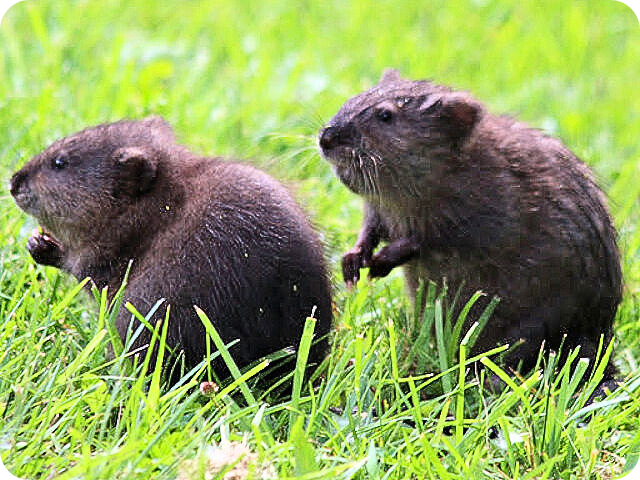
sizes vary, and 5 or 6 kits per litter is common.
There is evidence that muskrat populations may be
somewhat cyclic. Muskrats produce fewer litters when
populations are dense and more litters when
populations are sparse. The quality and abundance of
food also affects the number of litters as well as
litter sizes.
Female muskrats born in the spring are sometimes capable of raising their own litter by late summer or early autumn. An average female muskrat will raise about 15 or 16 young in a good year. One female muskrat has been known to produce 46 young in one year. The gestation period for muskrats is 29 days. Muskrats are thought to have one mate during rearing seasons.
Habits
Muskrats are somewhat sociable with others of the
same species, but will often fight to the death as
populations become dense. Preferred foods include a
variety of vegetation, including roots, stems, and
buds. Muskrats often seek out undercut banks for
protection while feeding. Food is usually carried by
this furbearer by mouth, and eating takes place
above the water level. Muskrats are often active
during the day, as well as night, with peak
activities near dawn and dusk. Muskrats commonly
stay underwater for five minutes while searching for
food and they are capable of holding their breath
underwater for 10-12 minutes. Territory sizes vary
according to population densities and the quality of
the habitat. These territories average about 200
feet in diameter in marsh habitats, and slightly
longer along streams. Dispersals occur when the
young are encouraged to leave the dens. Most of the
young muskrats do not move further away than 200
feet in good habitats. Adult muskrats sometimes
disburse further distances, particularly in the
early spring before mating season begins.
In many marshy areas muskrats build dome shaped lodges of vegetation in the water, similar to beaver lodges, but smaller in size, these lodges have one or more underwater entrances, and commonly house an entire family group. Smaller but similar structures are known as "push-ups". These push-ups usually serve a muskrat as a protected feeding and resting area, especially after ice forms on the water surface. Bank dens are common and these usually have underwater entrances leading upwards to hollowed out chambers in the bank above the waterline. Trails of air bubbles can often be seen through thin ice. These bubble trails are made by muskrats exhaling air as they swim beneath the frozen surface.
General
Uncontrolled muskrat populations do cause damage to
private property and habitat. Hole digging
activities undermine earthen dams and dikes. Damages
also occur to irrigation canals and farm ponds.
Large populations of muskrats also cause "eat-outs".
These areas are simply overcropped by the feeding
activities of the muskrats and the loss of
vegetation and resulting silting makes the area less
productive for other wildlife species as well.
Muskrat "eat-outs" often destroy the roots of the
vegetation, and it may take 15-20 years for the
habitat to return to its original capacity to serve
wildlife.
Muskrats are an important prey for a variety of wildlife, including mink, fox, coyotes, hawks and owls.
One major disease is Errington's disease. This serious virus can live in mud and infect muskrats in areas that have been uninhabited by other muskrats for as long as 5 years. Epidemics can and do occur with this devastating disease. Muskrats are also vulnerable to tularemia, and a variety of internal and external parasites.
Few muskrats attain four years of age.