
Gray Wolf
Canidae Family
Classification: Big Game*
Canis lupis
Order:
Carnivora
Family:
Canidae
Status: Wolves are managed in Idaho in compliance with federal law and the state conservation and management plan. Idaho maintains sustainable hunting and trapping harvest opportunities for wolves through regulated seasons
* Wolves may be hunted and trapped in Idaho
Best Management Practices
 Identifying
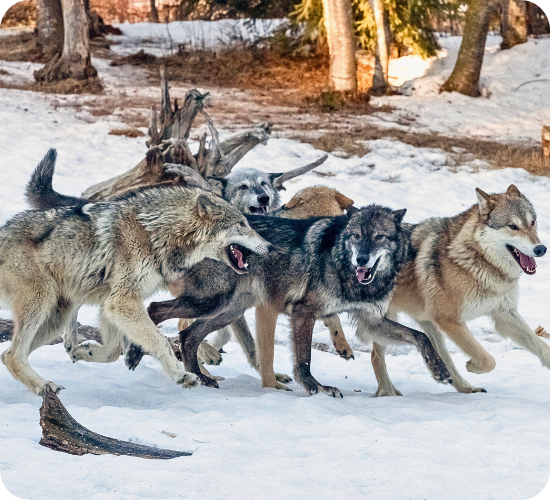
Characteristics: Hair color variable even
within populations; litter mates often express great
variety. White, cream-colored, buff, tawny, reddish,
gray, black, and mottled combinations thereof. All
black wolves possible due to early hybridization
with domestic dogs. Graying with age. The Gray Wolf
is the largest of the wild dogs. About half
the Gray Wolves in Montana are black with the other
half gray. Both color phases may be found in a pack
or in a litter of pups.
Identifying
Characteristics: Hair color variable even
within populations; litter mates often express great
variety. White, cream-colored, buff, tawny, reddish,
gray, black, and mottled combinations thereof. All
black wolves possible due to early hybridization
with domestic dogs. Graying with age. The Gray Wolf
is the largest of the wild dogs. About half
the Gray Wolves in Montana are black with the other
half gray. Both color phases may be found in a pack
or in a litter of pups.
Total length: 70 to 73 inches. Weight: 80 to 110 pounds.
Habitat: Found living in forest, prairie, tundra, desert, and swamp; even living near or within large cities. Adapted to live across an extreme range of temperatures. The Gray Wolf exhibits no particular habitat preference except for the presence of native ungulates within its territory on a year-round basis. Gray Wolves establishing new packs in Montana have demonstrated greater tolerance of human presence and disturbance than previously thought characteristic of this species. They have established territories where prey are more abundant at lower elevations than expected, especially in winter.
Food Habits: Gray Wolves are opportunistic carnivores that predominantly prey on large ungulates. Main prey items include deer, Elk, and Moose. Bison are also taken where the ranges of the two species overlap in and around Yellowstone National Park. Domestic livestock such as cattle and sheep are also preyed upon. Gray Wolves may also eat alternative prey, such as rodents, vegetation and carrion. Gray Wolves commonly hunt in packs, but lone animals and pairs are able to kill prey as large as adult Moose.
Life History: Active day and night; remain with young pups during daylight hours. Travel alone late spring to summer; pack members form nomadic hunting groups late summer to early spring. Hunt within a cooperatively defended territory.
Similar Species: Coyote
Ecology
In most areas, Gray Wolves are territorial
throughout the year. Packs generally consist of a
socially dominant pair, their offspring of the
previous year, and new pups, although other
breeding-age adults that may or may not be related
to the alpha pair may also be present. More than 1
female in the pack can breed and give birth to pups.
Pup survival when there are multiple litters is
highly variable. Pack size varies and may include as
few as 3 and as many as 37. In the Glacier National
Park area, packs generally include 8 to 12
individuals. Packs share pup-rearing
responsibilities including food provisioning and
tending pups at the den or rendezvous sites. Pack
activity is centered on the den site and nearby
rendezvous sites from late April until September.
Lone Gray Wolves may move through territories of
established packs. Pack territories are dynamic and
change from year to year depending on prey
availability, Gray Wolf populations, and
relationships with neighboring packs.
Summer home ranges are smaller than winter ranges; the annual range may be up to several hundred square miles. In the Glacier National Park area, territory size averages around 300 square miles. Gray Wolves may occasionally move several hundred miles, especially dispersing young.
Life Cycle
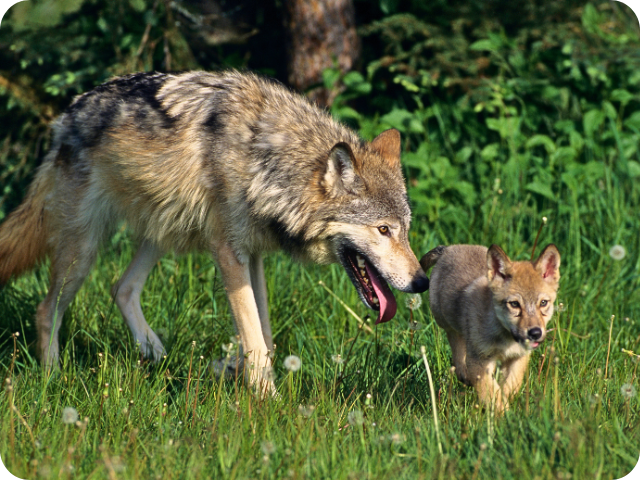
In Montana, Gray Wolves breed in mid- to late
February, with gestation lasting about 63 days. A
female can only give birth once a year. Breeding
usually occurs between the dominant male and female
in the pack and Gray Wolves normally do not breed
until they are at least 22 months old. More than 1
female in a pack may breed, resulting in more than 1
litter per. Young are typically born in late April
in an underground burrow that has been abandoned by
another mammal or dug by Gray Wolves. In
northwestern Montana litter sizes range from 1 to 9.
Pups emerge from the den in about 3 weeks and are
weaned in about 50 days. Young vacate the den when
they are about 3 months old and move to a series of
rendezvous sites throughout the pack's territory.
The pups are large enough to travel with the entire
pack by September. Some offspring remain with the
pack and others disperse as they mature. Lone Gray
Wolves generally do not successfully rear young, but
they may if food is abundant.
Pup survival is
variable and influenced by a number of factors
including disease, predation, and nutrition. Pup mortality was most often attributed to
human causes, but canine parvo virus was strongly
suspected as a main factor in low pup survival in
Yellowstone.
Migration
This species is not migratory but may move
seasonally following migrating ungulates within its
territory. Gray Wolves also disperse widely. Males
in northwestern Montana can move an average of 70
miles from their natal territory, and females 48
miles, before establishing a new territory or
joining an existing pack. Dispersal peaks twice per
year; first in January/February and second, in
May/June. Some Gray Wolves are known to have
dispersed up to 500 miles. Dispersal has been
documented from Canada, Idaho and Wyoming to
Montana. Montana Gray Wolves are also known to have
dispersed to Canada, Idaho, and Wyoming.
Background
The gray wolf was extirpated from the western United
States during the 1900s, primarily due to loss of
habitat and conflicts with people.
Although
wolf packs were eliminated from Idaho by the
1930s, tracks, scat, and/or observations of large canid-like animals were either reported or those
animals were killed up until the 1970s. Most are
thought to have been dispersers from Canada and
little to no successful breeding activity was
evidenced or sustained consistently through time.
The U.S. Fish and Wildlife Service listed the
northern Rocky Mountain gray wolf as endangered
under the Endangered Species Act in 1973.
In
1980, the Northern Rocky Mountain Wolf Recovery Team
completed a plan that would guide wolf recovery
efforts for a future wolf population in the northern
Rockies of Montana, Idaho, and Wyoming. The recovery
plan was revised in 1987. The plan designated three
recovery areas - Northwestern Montana, Central
Idaho, and the Greater Yellowstone.
Wolves from
Canada began to naturally colonize the Glacier
National Park area in 1979, and the first wolf den
in the western U.S. in over 50 years was documented
there in 1986. The wolf population grew as a result of natural reproduction and
dispersal. By the end of 1994, there were about 48
wolves in and around Glacier National Park.
In 1995, three family groups - a total of 14 wolves
- were trapped captured near Alberta's Jasper
National Park, transported to Yellowstone National
Park, and placed in acclimation pens. Two of the
females subsequently denned and produced nine pups
in Montana.
Also in the winter of 1995, 15
wolves were reintroduced into the wilderness areas
of central Idaho. These animals moved widely
throughout central Idaho and beyond. Many of these
wolves moved north, some to the upper Bitterroot
Valley. In 1996, three packs produced 11 pups.
In the winter of 1996, 17 wolves were captured
near Fort St. Johns, British Columbia, Canada and
were again released into acclimation pens in
Yellowstone National Park. Twenty wolves were
released in central Idaho. These translocated wolves
were the same subspecies that existed in the
northern Rocky Mountains historically.
Wolves were not released within Montana, but wolf
populations in Yellowstone National Park and central
Idaho grew rapidly and soon became a source for
dispersers to Montana. New packs formed outside the
earliest core wolf areas and overall wolf
distribution expanded. Wolf dispersal has been
documented between and among all three federal
recovery areas and the states comprising the
northern Rockies.
By the end of 2002, the
northern Rockies wolf population met the biological
recovery criteria of at least 30 breeding pairs in
the northern Rockies for three years in a row. By
the end of 2004, there was an estimated 835 wolves
and 66 breeding pairs in the tri-state area. In
Montana, there were about 153 wolves in 15 breeding
pairs at that time.
Wolf populations in the
Northern Rocky Mountains continued to expand and
reached recovery goals. With the exception of
Wyoming, they were delisted in 2011, giving
management authority to the states. The five-year
federal oversight period for Idaho and Montana ended
in 2015 and wolf populations remained well above
minimum federal management objectives of 15 breeding
pairs and 150 wolves in each state.
Management
While Idaho has full authority to manage wolves in
the state, federal regulations continue to guide
management practices. To remain in compliance with
federal law, IDFG’s conservation and management
program aims to maintain the overall population high
enough to prevent its reclassification as threatened
or endangered under the Endangered Species Act.
Idaho Fish and Game is the lead
agency for Gray Wolves, including population
monitoring, resolving wolf-livestock conflicts,
research, and public outreach. Federal regulations
continue to guide management practices.
Distribution and
Status
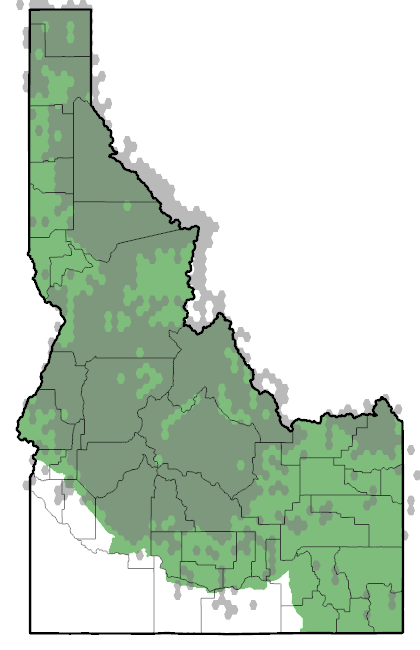
Wolves occur throughout Idaho.
They are managed and protected by regulated harvest
seasons.